“To keep your body and your brain healthy, it’s best to train them together”


BLITS, the Brussels Laboratory for Exercise and Top Sport, overlooks the athletics track and swimming pool of the VUB from its spot at U-Square. Over 10,000 recreational and advanced athletes have already come here for an exercise test and/or a sports medical screening. “Beginners shouldn’t start off too hard,” warns Professor Bart Roelands. “We provide them with personalised training advice so they can build up gradually.”
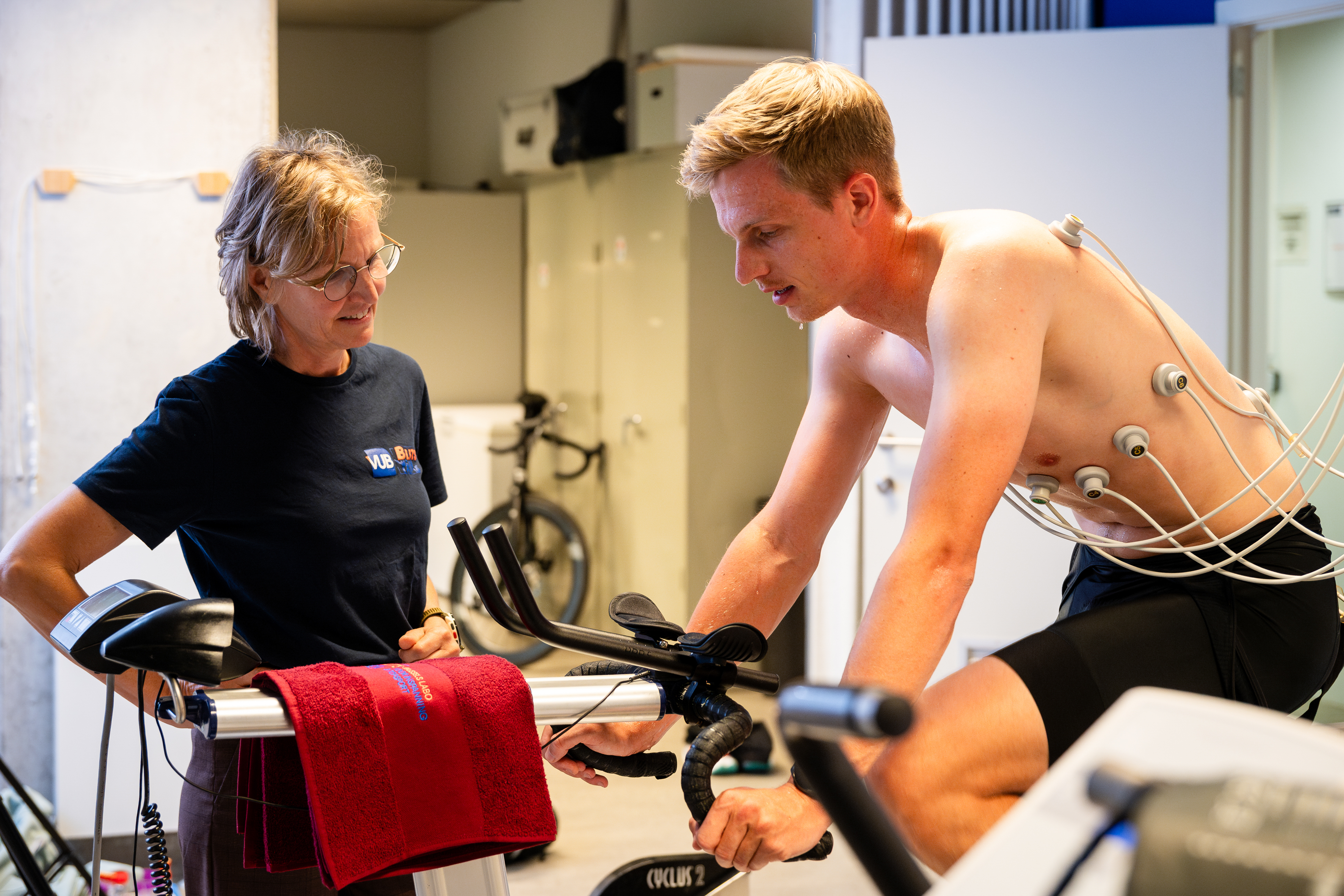
Treadmills, bikes (including turbo trainers), rowing machines – you won’t move an inch in the BLITS labs, but the sweat certainly flows. Most visitors come here for a maximal exercise test, explains Professor Bart Roelands from the MFYS research group (Human Physiology and Sports Physiotherapy). “Participants run, cycle or row in stages, increasing the intensity every 3 minutes until they reach their limit – hence the term maximal exercise test. During the test, we monitor heart rate, breathing, and blood lactate concentration. The latter is measured with a small prick to the earlobe. Together, these data provide a clear picture of the athlete’s fitness and performance capacity.”
What do you do with those results?
Bart Roelands: “Based on the findings, we offer tailored training advice. That way, you can improve your performance at your own level – without overloading or risking injury.”
"When you exercise, your physical parameters are constantly changing"
A simple tip for beginners is that you should still be able to talk while running.
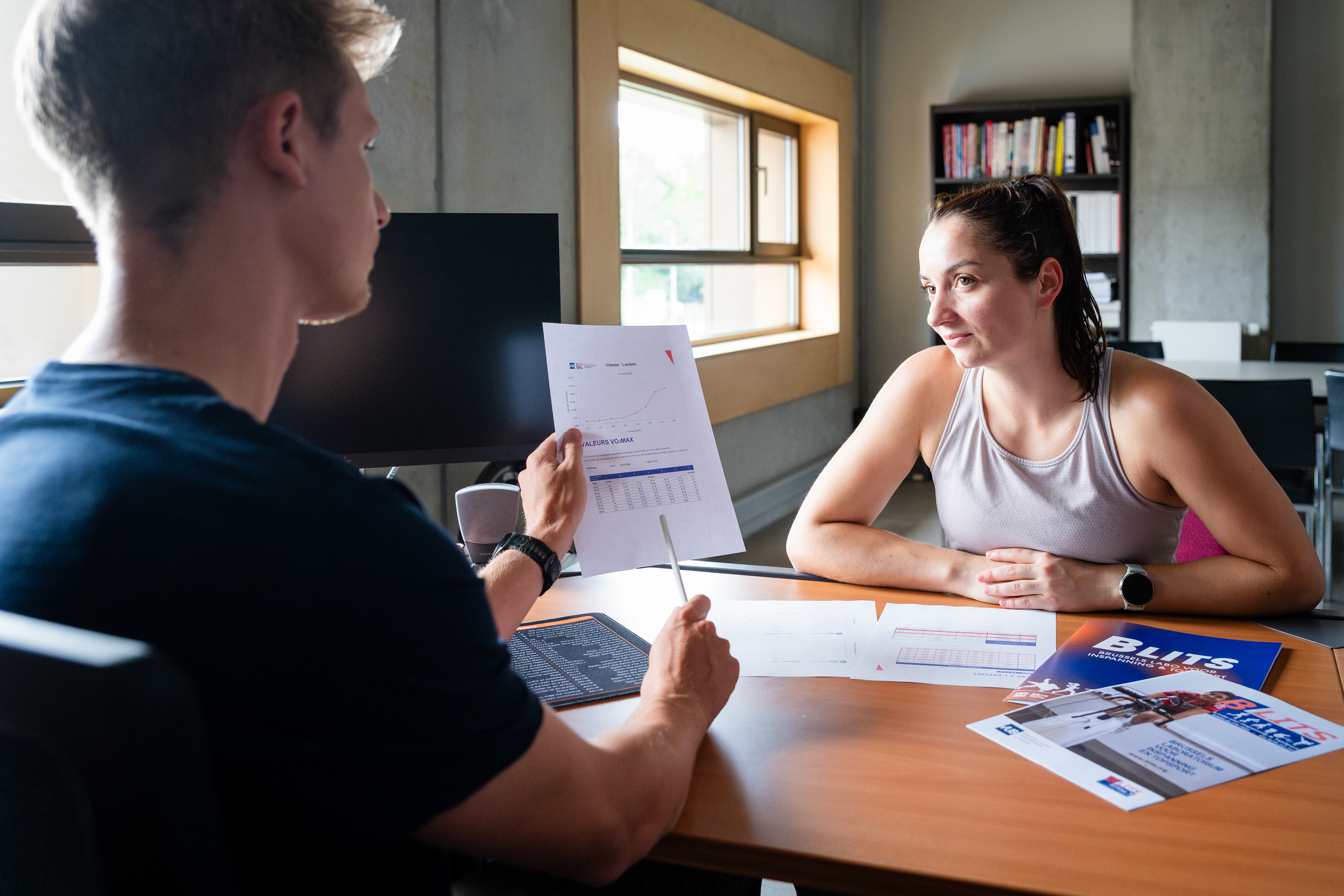
“That’s useful advice, but our training plans are scientifically grounded and much more refined, fully tailored to the individual. For example, we check your lactate values at specific heart rates. This allows us to give you heart rate zones to train in. The advice might be: run for a certain number of minutes at a heart rate between 125 and 145 beats per minute. Training this way is much more effective.”
Does everyone benefit from such an exercise test?
“Yes. Beginners can build up safely and reduce their risk of injury. You shouldn’t start too fast if you’re not used to it. Slow and steady is the message. But we also guide ambitious recreational athletes and professionals – a few years ago football players from Anderlecht, Union and Mechelen came here for tests. Since physical parameters change constantly when you train, you can keep adapting your training accordingly.”

Isn’t such a maximal test expensive?
“We offer group discounts through sports clubs. For individual athletes the standard price is 200 euros. But that includes a full package. You first visit our sports doctor for a thorough medical screening, including an ECG. If you’re cleared, you move on to the maximal exercise test with lactate measurement. After the test you can shower and catch your breath while we process the results. Then we go over everything with you and give you your personalised training plan. In total it takes about 1,5 to 2 hours. You only need to come once for the whole package.”
Some sports clubs require their members to have a medical licence. Can you get that here too?
“Absolutely. For example, the swimming federation relies on us for that. We also offer a special screening for athletes suspected of being overtrained. The TOP test – short for Training Optimisation Test – was developed by my predecessor Professor Romain Meeusen. It lasts 6 hours and includes a double exercise test, a hormone analysis from blood samples and sessions with a sports psychologist and a sports dietitian.”
"Mental fatigue reduces physical performance – an underestimated factor in sport"
You’ve been researching the impact of mental fatigue on physical performance for years.
“That’s an underestimated factor in sport. Mental fatigue reduces physical performance. If you’ve been stressing behind a computer all day, your evening run won’t feel as smooth. For an amateur that’s not a disaster – you’ll still enjoy it. But for professionals it’s crucial information.”
What makes a top athlete mentally tired?
“Playing video games on the bus to a match, having to give interviews beforehand, a coach’s endless pep talk… it can be anything. We work with Brazilian researchers who looked at the effect of stadium noise. Even the hum of the crowd proved to cause cognitive fatigue.”
Riders in the Tour de France leader’s jersey often complain about the mental pressure it brings.
“The race leader can’t just leave straight away. After a brutal stage he still has to go on the podium and give interviews. Because of these obligations he gets to the massage table later, arrives later at the hotel, eats later and may sleep worse. That’s physical, but also very much mental – and it gives an advantage to the chasers.”
In football, many goals are scored in the last ten minutes. You claim that’s not only down to physical fatigue.
“Exactly. Football involves a lot of thinking. Players must follow the coach’s instructions, listen to teammates, anticipate the opponent’s tactics and pick up the referee’s signals – all under pressure, with shouting fans, music and noise in the background. The cognitive load is huge, and mental fatigue peaks towards the end of the match. It’s always a combination of the physical and the mental. Even if you’re in top shape, mental fatigue can drastically affect performance.”
Can you also train that mental side?
“Yes, that’s called Brain Endurance Training or BET. It’s a recent and fascinating development, still in its early days of research. Professional cyclists already do this in part without realising it, through long, monotonous solo training sessions in all kinds of weather. That trains their mental resilience. It makes them less vulnerable to fatigue than recreational riders. But you can also practise Brain Endurance Training deliberately.”
How?
“While you’re physically training, you also push your brain with cognitive tasks: reaction tests, memory challenges, mental arithmetic… For example, you ride on rollers while counting backwards from 500 to 0 in steps of four. This way you train your brain to function efficiently even under physical strain and stress, improving your endurance, focus and reaction time. Does it work? More research is needed, but in elite sport the difference between winning and losing is often found in those marginal gains.”
Can less gifted athletes also benefit from Brain Endurance Training?
“We suspect so. Think of older people who want to stay strong physically and mentally. To keep both your body and your brain healthy and active, it’s best to train them together.”
Bart Roelands is a researcher in the Motor Function, Physical Activity & Sports (MFYS) research group at the Vrije Universiteit Brussel (VUB). His work focuses on the role of physical activity, fatigue and motor function in both sport and health. By linking movement, performance and wellbeing, he aims to understand how the body performs and recovers, with applications in both athletic performance and clinical rehabilitation.

The rector and the climate chamber
In Building F, the biologists recently gained access to 6 climate chambers. These are enclosed, controlled plant growth rooms where light, temperature, humidity and CO₂ levels are precisely regulated. Researchers can use them to test, for example, how different plants respond to warm, cold, wet or dry conditions, or to simulate which species might withstand the higher temperatures and CO₂ levels caused by climate change. BLITS has a similar climate chamber – but designed for athletes instead of plants.
Bart Roelands: “Our chamber is a controlled environment with a treadmill, a bike and a rowing machine. We can set the temperature anywhere between 5 and 50°C, the altitude up to 6,000 metres, and humidity from 0 to 100 percent. This allows athletes to undergo exercise tests and prepare for competitions in extremely hot or cold countries, or at altitude.”
Adventurous travellers and VUB researchers also make use of the BLITS climate chamber, Bart explains. “Recently, 2 people trained here before a trek in Peru. And in 2016, when Paul De Knop, former rector of the VUB, joined a Himalayan expedition, he came here to acclimatise to the thin air. We can even incline the treadmill to simulate climbing. And upstairs we have 2 hotel rooms that can also be set to altitude, enabling full day-and-night high-altitude training.”
In this article:
- Why can both beginner and experienced athletes benefit from an exercise test?
- How can an exercise test help you train smarter and avoid injuries?
- How does mental fatigue affect athletic performance?
- Can you train your brain to perform better during physical exercise?