
“100,000 parked cars to become one giant battery for green energy”


MOBI is one of the VUB’s flagship research groups. With 125 scientists from dozens of nationalities, the team is helping to shape the future of electric vehicles. “We founded MOBI nearly twenty years ago,” says founder and director Professor Joeri Van Mierlo. “Back then, China was barely on the map. Now, they’re overtaking the Western car industry left, right and centre. It’s high time we stepped up our game.”
"If I have seen further, it is by standing on the shoulders of giants," Isaac Newton is said to have once remarked. For MOBI, that giant was Professor Gaston Maggetto. A true visionary, says Joeri Van Mierlo. “The early 1970s were marked by the first oil crisis and a growing environmental awareness,” Van Mierlo explains. “Gaston Maggetto recognised the potential of electricity in transport long before it was taken seriously. He decided to dedicate his research to electrically powered vehicles. At the time, many dismissed it as fanciful, but history has proven him right. He earned international recognition for his work.”
Nearly twenty years ago, Joeri Van Mierlo helped lay the foundations of MOBI, building it into a truly interdisciplinary research group.“Within the team, engineers work alongside economists who calculate the total cost of ownership for electric vehicles – meaning all the costs incurred over the vehicle’s entire lifespan. We also conduct life cycle analyses to map out the environmental impact of each material, from mining and production to end-of-life recycling. And we study consumer behaviour too, because we want to understand how people respond to new technologies like self-driving cars.”
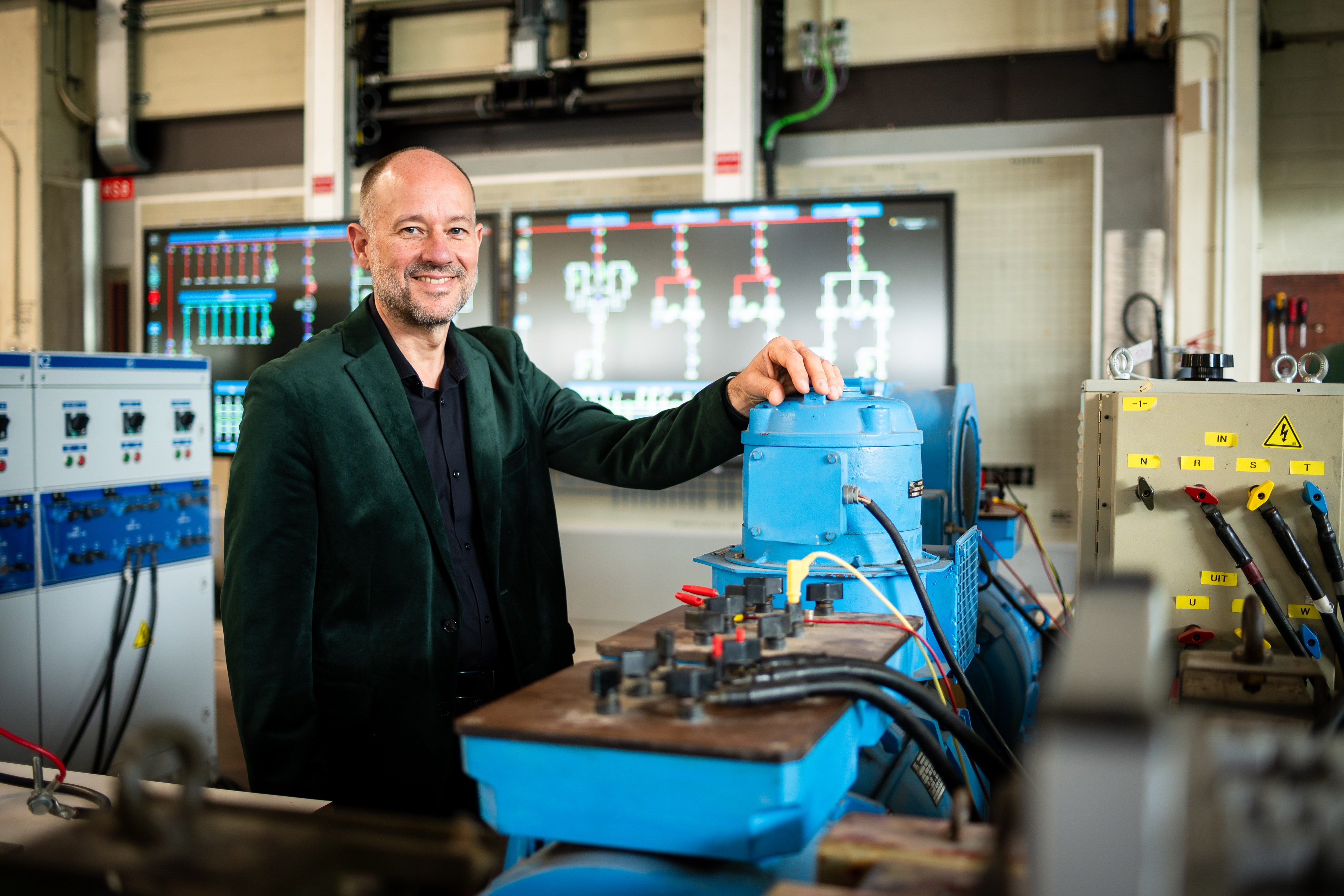
Joeri Van Mierlo has since become a giant himself for the next generation. MOBI has grown into Europe’s largest research centre and reference point for electric vehicle research. For Joeri, it is a childhood dream come true – with a little help from coincidence. “I studied and earned my PhD at VUB, and in between I also did my civilian service here. Two weeks later, compulsory service was abolished. Honestly, I never regretted it. I was fascinated by mobility, and one of my tasks during civilian service was to design a traffic safety plan for the campus. Hard to imagine now, but at the time there were no traffic lights or cycle paths on the busy roads around campus. There were regular accidents.”
That is how Joeri naturally rolled into the mobility theme. From the beginning, his main motivation was the fight against air pollution and climate change. For him, the electric car would play a central role. “Walking, cycling or public transport is always better, but a large share of journeys will continue to be by car. Just reducing car use from 70 to 60 percent already requires doubling public transport. We can’t do without cars anymore. Then they should at least be as environmentally friendly as possible. Electric, in other words.”
It is only in recent years that the electric car has truly broken through. The road to this point was long and frustrating, mainly because of the composition of the batteries. Half a century ago – when Elon Musk was still in nappies – nine striking blue electric cars were already driving around the VUB campus: heavy Italian models with welded steel bodies, used by staff and students to commute between the Etterbeek campus and the Jette hospital. Even in car-sharing, VUB was ahead of its time.
“They ran on lead batteries,” says Joeri Van Mierlo. “Their range was at most 40 kilometres. And as a driver, you needed strong muscles, because there was no power steering or brake assist. You had to slam the brake pedal with full force and hope you stopped in time.” (laughs)
“The holy grail of the sector: making batteries lighter, smaller and more compact – while still performing just as well”
Those iconic blue cars would have deserved a place in a museum. Sadly, they rusted away completely over the years. The research went on, though. In the 1990s, lead batteries were replaced by nickel-cadmium. To promote electric mobility, Joeri Van Mierlo drove from Brussels to Monaco in those years, in a caravan that also included colleagues Gaston Maggetto and Peter Van den Bossche. They regularly stopped to give demonstrations at town halls along the way. They had plenty of opportunity, since the range of nickel-cadmium batteries was still only 70 kilometres.
Joeri Van Mierlo: “The difference compared to today is enormous. Not long ago, I made a similar trip again – driving electrically back and forth to the Electric Vehicle Symposium in Sweden. I had mapped out in several apps which stages I would drive and where I would recharge along the way. But that turned out not to be necessary: driving 500 km without stopping is already a challenge for the bladder and for fatigue. In recent years, there has been more than enough charging infrastructure added to avoid any problems.”
The big leap forward came with the introduction of the lithium battery. Although there is no such thing as the lithium battery. Lithium is always combined with other materials. By adjusting the amounts and ratios of those materials, significant improvements can still be achieved in many areas. Faster charging times, for example. How does Joeri view the recent stunt by Chinese manufacturer BYD: a battery that charges in just five minutes?
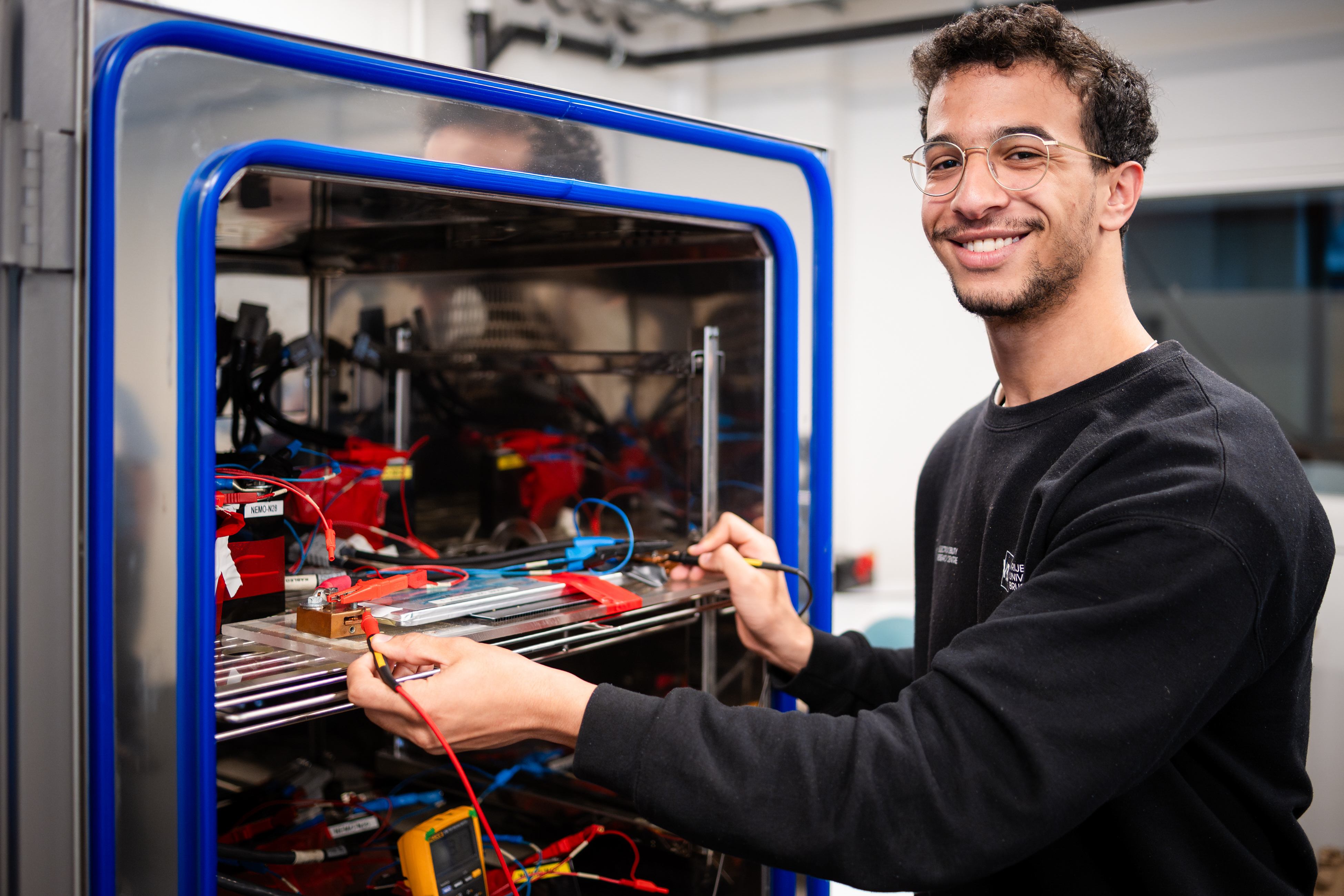
Joeri Van Mierlo: “Those five minutes don’t say much in themselves. Charging time is only one criterion. I immediately ask: is the battery affordable? How much energy can it store? How heavy is it? How big? How many times can it be charged and discharged? Is it safe? All those parameters matter.”
In the Electromobility Lab in Building Z, MOBI already has everything needed to study these parameters. The building itself is a maze and shows its age, but every corner is packed with sophisticated, gleaming equipment. A recent acquisition is a device that can test 300 different battery cells simultaneously. They also recently invested in a so-called dry room, essential for building prototypes of new battery cells.
Joeri Van Mierlo: “With MOBI’s battery team, we are now strongly focusing on developing solid-state batteries. At present, there is liquid electrolyte between the anode and cathode of a battery. We want to replace it with a solid material. Expectations are high, because such a solid-state battery could be made more compact and lighter. That is the holy grail in the sector: batteries that are smaller, lighter and still work just as well, so we can also make the vehicles themselves smaller and lighter. Our EPowers colleagues, also within MOBI, are doing the same for power electronics – the components that transfer electricity from the battery to the motor and enable speed, acceleration and so on. That team recently opened a new lab to conduct lifetime tests on those components.”
“We are developing systems to charge and discharge smartly – at exactly the right moment”
For this kind of research, MOBI collaborates with other top-tier research groups across Europe, in countries like the Netherlands, Germany, and Sweden. These consortia apply for funding through European framework programmes and work closely with European car manufacturers. The ambitions are high and the economic stakes enormous: Europe wants to hold its ground amid the rising tide of Chinese electric vehicles — and perhaps even regain the lead.
“Twenty years ago, when MOBI was just getting started, China was barely on the map. Back then, Japan and South Korea were setting the pace. Things can change quickly. That should motivate us to push harder — ideally a gear up. Solid-state batteries could be a major step forward. Though of course, our Chinese colleagues aren’t standing still either.”

MOBI also takes a broader view than just the vehicle itself. The research group is also exploring how cars can be integrated into the electricity grid.
Joeri Van Mierlo: “We need to move towards a climate-neutral society, powered by solar and wind energy. But those sources aren’t always available. The electricity generated when the sun shines or the wind blows needs to be stored. That can be done using large stationary batteries, but electric vehicles offer an additional solution. All those car batteries together represent a huge storage capacity. If there’s a surplus of electricity, hundreds of thousands of parked cars could store it and feed it back later — to homes, businesses, or the grid. Together, they would form one giant battery. That requires bidirectional charging systems between the car and the home, so energy can flow back and forth as needed. We’re developing systems to manage this smartly — charging and discharging at exactly the right time.”
Speaking of smart: in the yellow units designed by Willy Van Der Meeren, MOBI researchers are also working on intelligent lighting for self-driving cars. “They’re developing technology that allows vehicle lights to transmit communication signals to other road users — for example, to warn that there are roadworks 500 metres ahead, or that a car has broken down. With Waze, users still have to enter that information manually. Self-driving cars will be able to do it automatically, without human input.”
Joeri Van Mierlo is professor at the Vrije Universiteit Brussel and founding director of the MOBI Electromobility Research Centre. He leads research on electric and hybrid vehicles, batteries, energy management and sustainable mobility. As one of Europe’s leading experts in electromobility, he has authored more than 500 scientific publications and is editor-in-chief of the World Electric Vehicle Journal. His work focuses on accelerating the transition towards cleaner, smarter and more sustainable transport systems.


In this article:
- How did an idea that was once dismissed become a European reference point for electric mobility?
- Why does the battery remain the key to the future of electric vehicles?
- Could parked electric cars help store solar and wind energy?
- How can Europe stay competitive as China sets the pace in the electric vehicle market?
Meest bekeken